
An Automated NSW Smart Solutions Guide
Publish Date: 02/05/2026
Why the Honeywell Optimizer Advanced Controller is the Best Migration Path from Siemens PXCM
Confession time. In 1998, I destroyed my dad’s Compaq Armada. I knocked over a bottle of Surge, and it poured all over the keyboard. I wiped it off and tried to pretend nothing happened, but that sweet Pentium 133 had clocked its last cycle. 133MHz. 80MB of RAM. 20 oz of sugary citrus soda. So went my dreams of hacking the Unix system at Jurassic Park.

Almost 30 years later, I’m trying to retire another admirable 133MHz/80MB dinosaur: the Siemens PXC Modular (PXCM). These controllers were fantastic back when we couldn’t get enough of PSY’s Gangnam Style and Auto-Tune the News. Now they struggle with modern network demands. The PowerPC processor has to juggle control execution, Ethernet traffic far beyond what it was designed for (thanks, BACnet/IP), and trend expectations that have exploded since these things were built.
Several platforms work well as PXCM replacements, but the best option right now is Honeywell’s Optimizer Advanced Controller. I’m calling it HOAC from here on out because that product name is way too long. I was going to write this as an essay, but nobody reads essays anymore, so here’s a listicle of why I prefer the HOAC for PXCM migrations.
6. It’s Niagara
Migrating to a new platform is stressful. The HOAC makes it easier because it’s a Niagara station, which means it supports any device with a Niagara driver. That includes serial and IP versions of Modbus and BACnet. The Niagara marketplace even has a P1 driver for Siemens TECs. Niagara is everywhere, so almost any technology you run into has a solution. That alone removes a ton of migration stress.
5. I/O Wiring Migration is Simple

The Siemens super universal module is solid hardware, but is it really “super universal”? Only 4 of the 8 terminals can be a 4-20mA output, and none can be digital outputs. The Honeywell 16 UIO module can put any point type on any terminal. This makes migration planning way simpler because you won’t have to rewire anything. The wires at address 1 stay at address 1. They’ll never move more than about 30 millimeters.
4. The Footprints Match Up

The HOAC has a self-forming IO bus and up to 4 RS485 ports, just like the PXCM. The Siemens super universal module takes up about 130mm for 16 points. The Honeywell IO modules take up 110mm for 16 points. Higher point density means you’ll never run out of space. The HOAC has similar IO bus electrical capacity too, though you might need supplementary DC power for heavy loop-powered inputs.
3. The Hardware is Solid
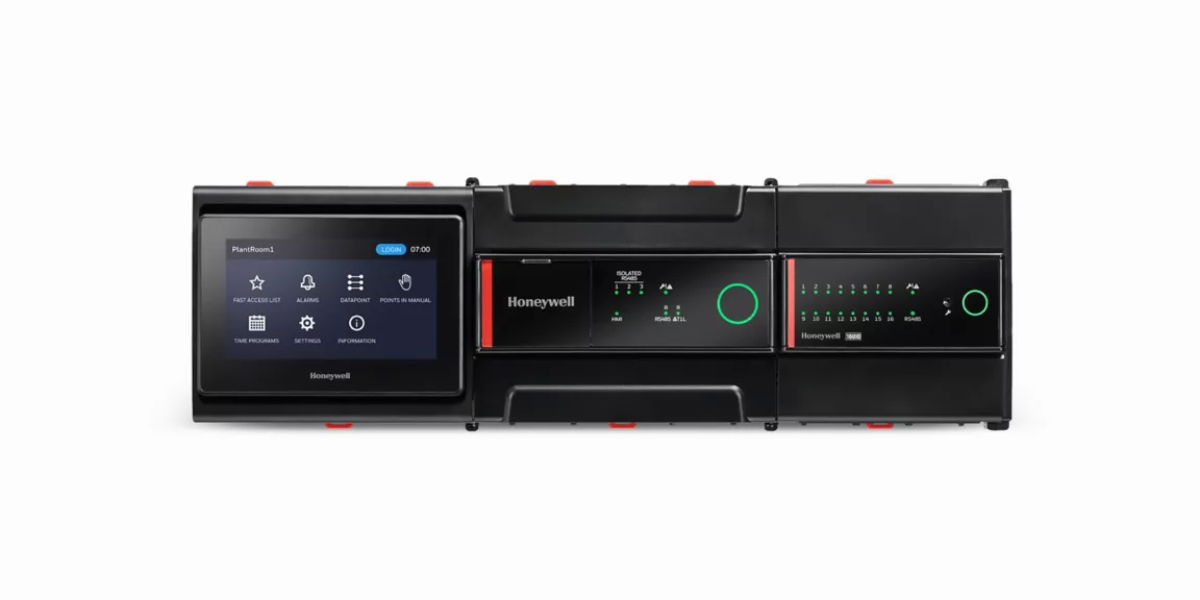
The HOAC comes with up to 4 Ethernet ports on two separate gigabit network interfaces. One is a dedicated connection. The other is a 3-port managed switch. You can MAC whitelist on a per-port basis and disable unused ports. The OS is 64-bit Linux. I’ve integrated multiple BACnet MS/TP trunks, IP devices, Modbus TCP devices, and an entire chiller plant worth of panelbus points to a single HOACV. I created histories for all my physical points and never came close to maxing out the 2GB of RAM. The 8GB of storage has been more than enough. Best part? You can pull the power and FLN plugs straight from a PXCM and plug them directly into the HOAC.
2. It Works Great with Siemens Field Devices
The recommended network design for Siemens DXR-model VAV controllers on a BACnet/IP network is to loop both ends of the floor-level ethernet trunk to a switch on the building automation network backbone. This design would cause a network storm due to loopback on an unmanaged network. As a result, Siemens typically either installs a single-ended network, or they install 3rd party managed switches in order to prevent loopback. The HOAC allows customers to get the reliability of the looped network without a 3rd party device by implementing RSTP on the onboard 3-port switch. That’s why I think that the HOAC works better with DXRs than PXCMs do.
1. It Works Great with Siemens Front-Ends

We’ve integrated HOACs with Desigo CC, Insight, Niagara, and Desigo Optic. They all worked well. Here’s the funny part: the HOAC integrated more easily with Desigo CC than the Siemens PXCM did. The PXC gets treated as an Apogee device, which makes custom State Text harder to import than it is for 3rd-party BACnet devices like the HOAC.
Conclusion
The HOAC isn’t just a replacement for the PXCM; it’s an upgrade. You get better hardware, easier integration, simpler migration planning, and the flexibility of Niagara without giving up compatibility with your existing Siemens infrastructure. If you’re still running PXCMs, it’s time to make the switch before those PowerPC processors finally give up like my dad’s old Compaq.