
An Automated NSW Smart Solutions Guide
Publish Date: 12/04/2025
The Problem
The conventional approach to controlling humidity in a space uses relative humidity as the control variable. Common problems with this approach include hunting of the control equipment and inaccurate results. We have found that using dew point as the control variable provides a more stable system and better response of the controlling equipment.
The Answer Starts With Psychrometrics
Psychrometrics is the study of gas-vapor mixtures, in our case, air and water. Using a psychrometric chart, you can predict changes to relative humidity and dew point with changes in temperature.
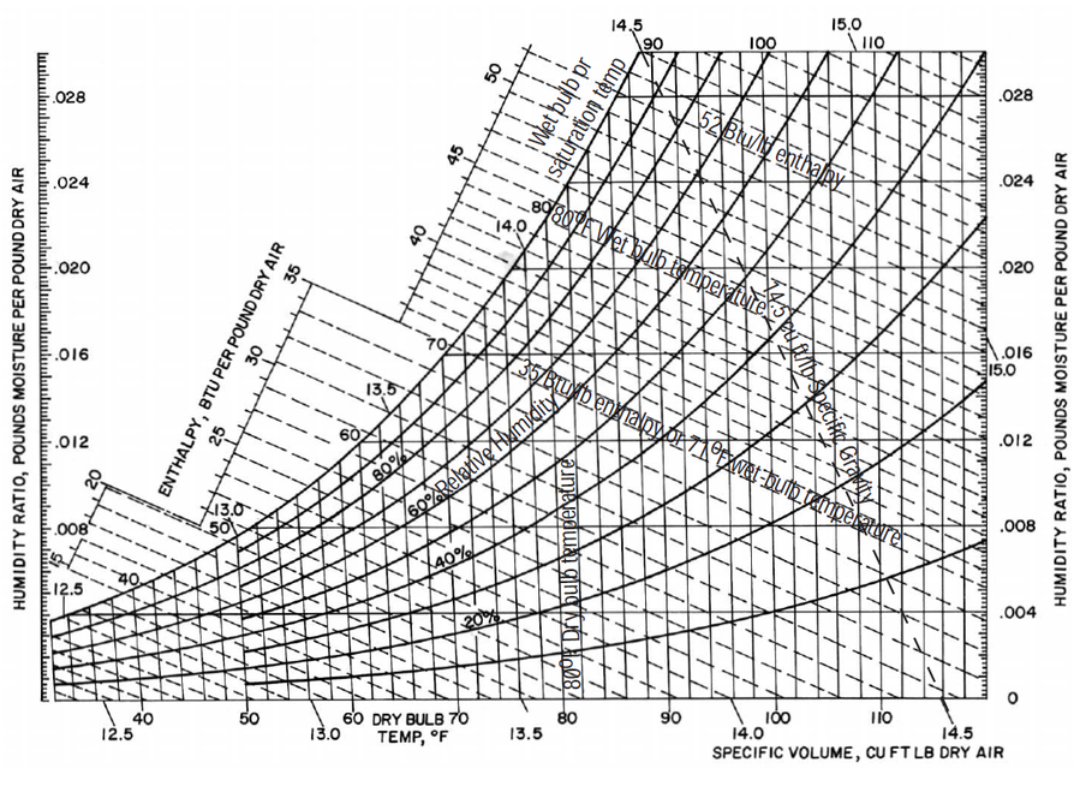
Temperature (Dry Bulb): The air temperature measured by a standard thermometer.
Relative Humidity (RH): The percentage of moisture in the air relative to how much it can hold at its current temperature.
Dew Point: The temperature at which the air would become completely saturated with water.
This chart can be confusing, so the way we teach young engineers and technicians about psychrometrics is by using the following metaphor.
The Magic Cup of Water Metaphor
Imagine you have a magic cup that can change size. In this metaphor:
- Cup size = Temperature (larger cup = warmer air, which can hold more moisture)
- Amount of water in the glass = Absolute moisture content (the actual amount of water vapor in the air)
- How full the glass as a % = Relative Humidity (RH%)
- Dew Point = Cup size at which the water overflows (the temperature where condensation occurs)
Let’s say you have a specific amount of water that fills your glass halfway; That would represent 50% relative humidity.
Without changing the amount of water, the magic glass grows (temperature increases), and now the water only takes up 25% of the glass’s volume (relative humidity drops to 25%). The actual moisture didn’t change, but RH dropped dramatically just because the temperature increased.
Now, let’s say the magic glass shrinks (temperature decreases) so much that the water in the glass overflows. When the glass grows back to the original size, the water only takes up a quarter of the glass(25% RH). This scenario shows that actual moisture can only be changed by reducing cup size(temperature) below the dew point to force water condensation. When the cup size returned to normal, the RH was lower than when it started.
Why this matters for control: When you control based on RH, normal temperature swings make your system think total moisture has changed when it hasn’t. Your equipment fights temperature fluctuations instead of controlling actual moisture. Controlling to dew point targets the real moisture content directly, giving you stable, accurate control regardless of temperature changes.
The Different Control Methods
Temperature and Relative Humidity (RH) Only Control
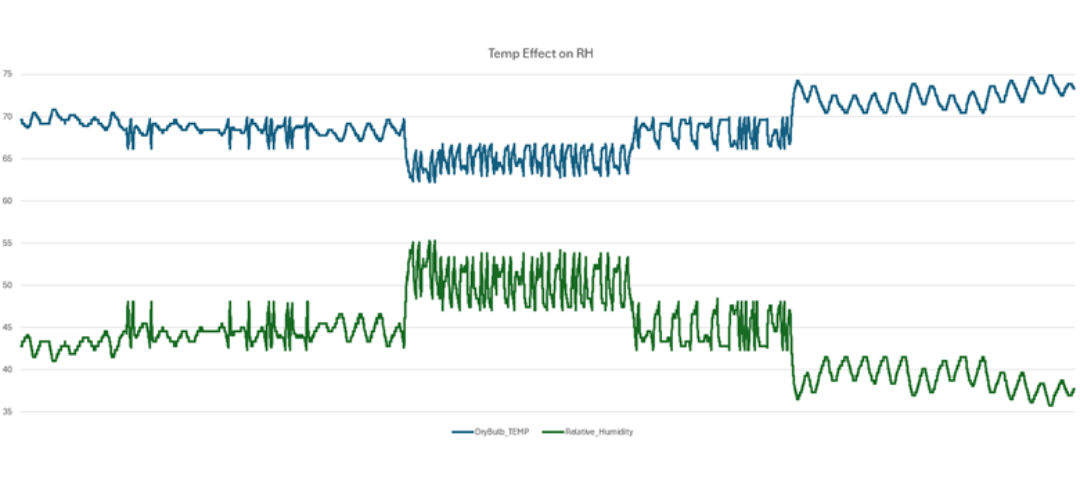
The following graph shows how relative humidity is affected by changes in temperature. Note: For this example, the amount of moisture in the air is constant. You can clearly see that humidification/dehumidification efforts would chase the oscillation based solely on temperature fluctuation.
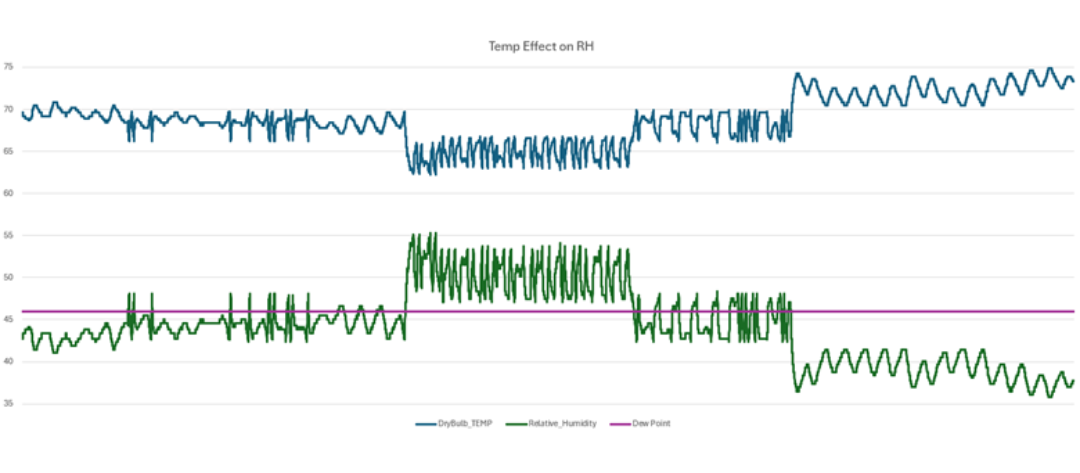
Here is the same graph with the corresponding dew point line drawn in purple. It is clearly a more stable variable to control.
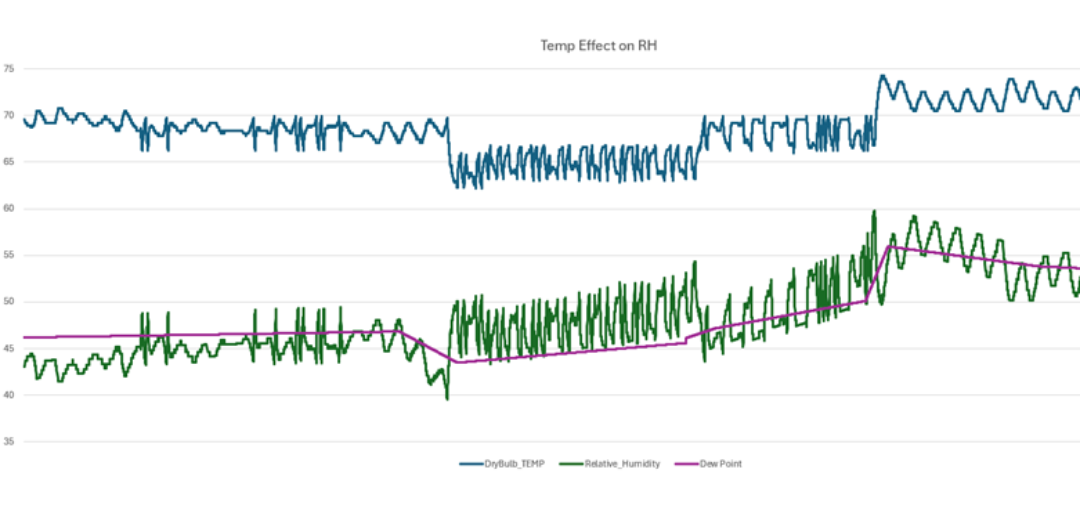
Now let’s take the same graph, but this time the moisture content will vary, causing the dew point to change (similar to what routinely happens with outside air conditions). You can see the RH line still oscillating with temperature, but now it is also riding up and down with the dew point line.
Temperature and Dew Point Control
In the following scenario we are going to control dew point based on temperature and relative humidity set points.
- Temp Setpoint = 70°F and a RH Setpoint = 45%
- Dew Point Setpoint = 47.7°F (derived from the temp and RH set points)
The same graph with set points added shows where humidification/dehumidification should occur (purple solid line vs dotted line). This assumes that RH will not be at set point if temperature is not maintained at set point.
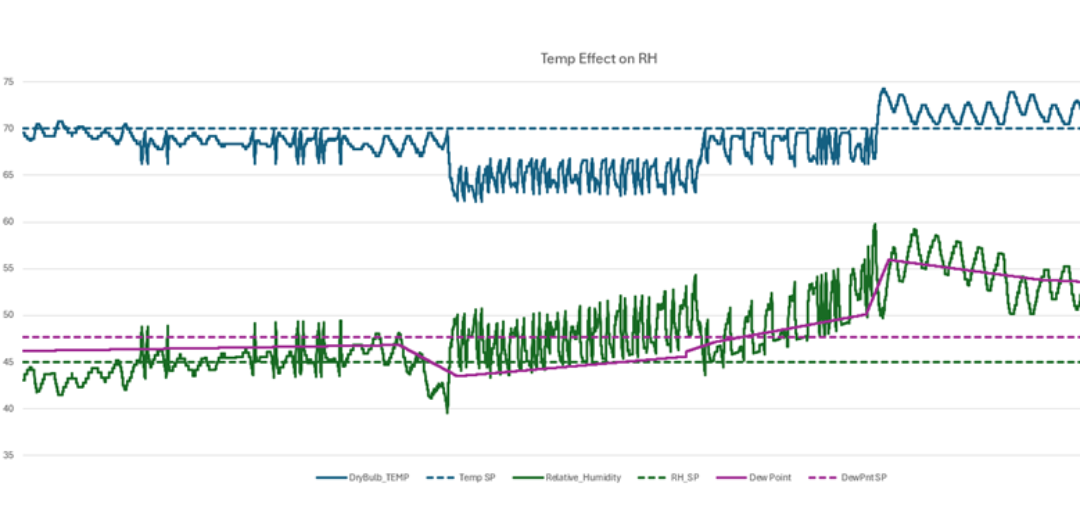
Your control system now responds only to actual changes in moisture content (dew point), not temperature fluctuations. This eliminates hunting and provides stable, accurate humidity control.
The Dew Point Control Strategy
Controlling humidity using dew point instead of relative humidity eliminates instability caused by temperature fluctuations. Since dew point directly represents actual moisture content, your control system responds only to real moisture changes, ignoring misleading RH variations from temperature swings.
By deriving a dew point set point from your temperature and RH targets, you get a control strategy that works with the physics of air and water vapor. This delivers more stable operation, less equipment hunting, better accuracy, and improved system performance and energy efficiency.